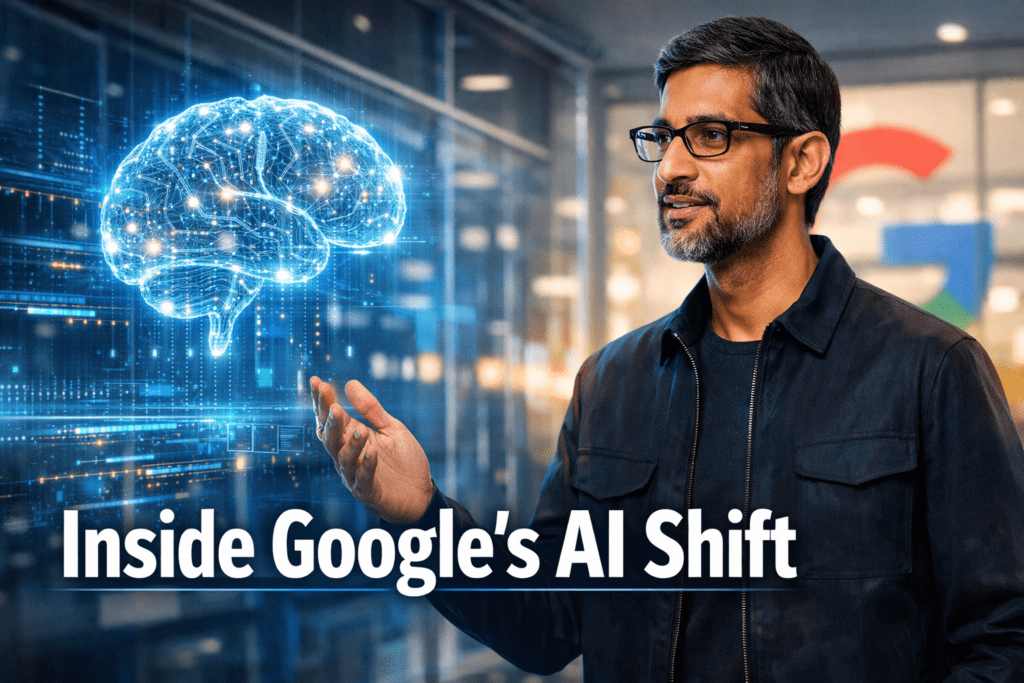
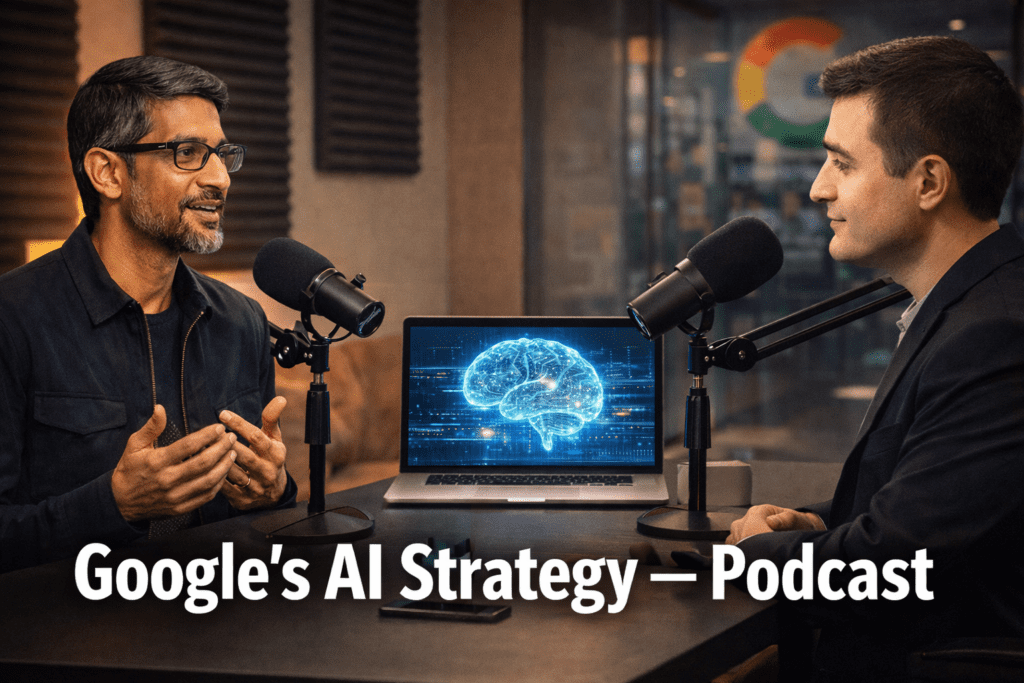
The day after Google I/O 2025, Sundar Pichai sat down for an unusually candid conversation about the future of technology. What emerged wasn’t just another corporate interview about product launches. Instead, the Google CEO revealed how the company is navigating the most significant platform transformation since the smartphone revolution—and why this shift could be even more profound than the internet itself.
The Confidence Behind Google’s AI Push
There’s a palpable shift in how Google talks about artificial intelligence now. Gone are the cautious qualifiers and distant timelines. In their place is something different: confidence born from shipping real products that people actually use.
When asked what drove this change, Pichai pointed to something deeper than any single product announcement. Google has been pushing the AI frontier across multiple dimensions simultaneously—from foundational research in text diffusion models to practical applications in consumer products. The company calls this approach “research becomes reality,” and it’s finally bearing fruit at scale.
What makes this moment distinct is the breadth of impact. AI isn’t improving just one product line. It’s transforming Google Search, YouTube, Cloud services, Android, experimental projects like Waymo, and even scientific tools like AlphaFold. Few technologies in history have had the potential to revolutionize such a wide range of businesses simultaneously.
Understanding the New Platform Shift
Every major platform shift changes how humans interact with technology. The mobile revolution brought multi-touch interfaces, ubiquitous connectivity, and location-aware applications. Suddenly, you could push a button and a car would arrive anywhere in the world. That single capability required years of foundational work across hardware, software, and networks.
But this AI platform shift operates differently. According to Pichai, previous platforms were static—they enabled new applications but couldn’t fundamentally improve themselves. AI represents the first platform capable of self-improvement and creation at every layer of the technology stack.
Think about what that means. When blogging emerged with the internet, it gave millions of people a voice who never had one before. Mobile cameras enabled a generation of video creators on YouTube. Each platform expanded who could participate in digital creation.
AI is poised to do something more dramatic. It will democratize software development itself. Through natural language coding tools, people who have never written a line of code will be able to build functional applications. The barrier between imagination and implementation is collapsing.
Pichai draws parallels to when Ajax transformed the web, enabling dynamic applications like Google Maps and Gmail. But he believes AI will turbocharge this creative power beyond anything we’ve seen before. The question isn’t whether new categories of products will emerge—it’s how many, and how quickly.
The Products Taking Shape
While general-purpose chatbots capture most attention, practical AI applications are emerging across multiple domains. Coding IDEs powered by AI have proliferated so rapidly it’s difficult to track them all. These tools are already standard in many development workflows.
Google’s own experiments reveal the diversity of possibilities. Notebook LM has found product-market fit by helping people process and understand complex information. The new Flow product enables creative work in novel ways. Meanwhile, enterprise applications are quietly transforming workflows—one doctor’s office now uses AI to transcribe appointments and generate reports automatically, a stark contrast to just two years ago.
But Pichai warns against judging AI’s potential by current applications alone. Gmail started as a 20% project used internally before becoming the foundation for Google Workspace and ultimately contributing to a multi-billion dollar cloud business. Waymo faced severe criticism three years ago, yet Google increased investment based on the underlying technology’s trajectory.
The mistake observers often make during rapid innovation is fixating on immediate business returns rather than recognizing when foundational technology is improving fast enough to unlock entirely new opportunities.
The Augmented Reality Horizon
Google has learned hard lessons from Google Glass to the present day. The distinction between AR goggles and glasses matters more than most people realize. While XR goggles are shipping later this year through Samsung partnerships, Pichai is particularly excited about the glasses collaborations with Gentle Monster and Warby Parker.
These products will reach developers this year, and crucially, they’ll be close to final consumer versions. The pace of development is accelerating. Pichai would be shocked if he weren’t wearing one during next year’s post-I/O interview.
But will these be mainstream, iPhone-level products? Not immediately. The bar for wearing something on your face is higher than carrying a device in your pocket, especially for people who need prescriptions or have other considerations. However, Pichai expects millions of people to be trying these devices within the next year—a meaningful milestone even if not yet mass-market adoption.
The announcement that Johnny Ive is joining OpenAI to work on the “future of computing” adds competitive pressure. Pichai admires Ive’s track record and sees this as validation that the moment for hardware innovation has arrived. When the internet emerged, Google didn’t even exist yet. If AI represents a shift bigger than the internet, entirely new companies and product categories will emerge that we can’t envision today.
The Web’s Evolution and Publisher Tensions
One of the most contentious aspects of AI’s impact centers on the web ecosystem and content creators. Publishers are furious about AI Mode, Google’s new search interface. The News Media Alliance called it “theft,” arguing that removing links eliminates the last source of traffic and revenue for publishers.
Pichai pushes back on this characterization firmly. Google remains committed to sending traffic to the web—something he claims no other major AI company prioritizes. The company is actually sending traffic to a broader range of sources than before, and the quality of referral traffic is improving as measured by time spent on linked sites.
The fundamental tension reveals a deeper transformation happening across media. The web as an application platform is arguably at an all-time high—sophisticated tools like Figma thrive as web applications. The web as a transaction platform is reaching new heights, especially with regulatory changes forcing more open payment systems.
But the web as a media platform? That’s where the crisis hits hardest. If someone were starting a digital media company today, they’d likely begin with TikTok or YouTube, not a traditional website with all its infrastructure dependencies.
Pichai isn’t entirely convinced by this assessment. He argues that AI will make cross-format creation nearly frictionless. When models are natively multimodal, converting content between formats becomes as simple as translation between languages. The static model of producing content in specific formats will give way to fluid transformation across whatever medium best serves the audience.
More importantly, the power to create sophisticated web applications is about to democratize in ways we haven’t seen in 25 years. If creating web presences becomes dramatically easier through AI coding tools, the calculus might shift entirely.
The Agent-First Web
Perhaps the most profound question about the web’s future came from Dennis Hassabis, who suggested that an agent-first web might look nothing like today’s web. Why render web pages for agents the way we render them for humans?
Pichai reframes this thoughtfully. The web is already a series of databases with user interfaces built on top for human consumption. For agents, you’d optimize differently—similar to how restaurants handle dine-in service differently from takeout.
The challenge is business model alignment. Companies like Uber, DoorDash, and Airbnb have spent enormous resources building customer relationships. Why would they let agents abstract them away and potentially reduce them to commodity service providers?
Multiple models could emerge. Consumers might pay subscription fees for agents, which then revenue-share with services. CIOs in enterprises can simply demand interoperability and pay for it as a solved problem. Market equilibrium will develop as some companies see business growth from agent participation while others resist disintermediation.
Pichai expects agent adoption to happen faster in enterprise contexts for exactly this reason—central decision-makers can mandate integration. Consumer markets will be messier, requiring clear value propositions for all parties.
The historical parallel is credit cards. Why do merchants accept them despite fees? Because participation drives enough additional business to justify the cost. Agent ecosystems will likely find similar equilibriums.
Navigating Political and Regulatory Pressure
Google faces mounting challenges beyond technology. The government wants Chrome sold. The Trump administration has transactional expectations. Publishers are demanding regulatory intervention.
On Chrome specifically, Pichai argues Google has been a net positive for the web—not just improving their own product but open-sourcing Chromium and advancing web standards through substantial R&D investment. As someone directly involved in building Chrome, he sees forced divestiture as misunderstanding the value Google provides to the broader ecosystem.
Regarding political pressure, Pichai draws clear lines. Google’s ranking algorithms are sacrosanct. No person at Google can manually influence rankings, and that won’t change regardless of political demands—including from Trump himself regarding his search rankings.
AI Mode presents different challenges since system prompts can dramatically alter responses. But Pichai maintains the same principle applies: rankings and core algorithmic decisions don’t change based on individual cases or political pressure.
The company operates under enormous scrutiny. When AI Overviews launched, the error rate was one in seven million for adversarial queries specifically designed to find mistakes. That’s the bar Google holds itself to because trust, once lost, is nearly impossible to regain.
The Next Frontier: Physical World Integration
When asked about the next phase of the platform shift, Pichai points to robotics. Online AI applications are transforming digital work, but the truly profound moment will come when AI translates into the physical world through general-purpose robots.
He already thinks of Waymo as a robot—it’s AI operating in the physical world. But when general-purpose robotics reaches that magical moment where it works reliably and affordably, it will represent a platform shift as significant as anything that’s come before.
What This Means for Everyone
The conversation reveals something crucial about this moment in technology. We’re not witnessing gradual improvement of existing tools. We’re in the early stages of a platform transformation that will reshape how humans create, work, and interact with information.
The companies and individuals who understand this aren’t just adopting AI tools. They’re fundamentally rethinking their assumptions about what’s possible, who can participate in creation, and how value gets generated and distributed.
Google’s confidence stems from seeing these possibilities clearly and shipping products that prove the technology works. But as Pichai acknowledges, entirely new companies will emerge from this shift—companies that don’t exist today and that may be hard to imagine from our current vantage point.
The web isn’t dying, but it is evolving in ways that challenge every assumption built over the past 25 years. Publishers, platforms, users, and developers are all navigating uncertainty about what comes next.
What seems certain is that five years from now, computing will look profoundly different than it does today. The question isn’t whether that transformation happens, but whether we’re prepared for the opportunities and challenges it brings.
Watch full video Of Google CEO Sundar Pichai on the future of search, AI agents, and selling Chrome