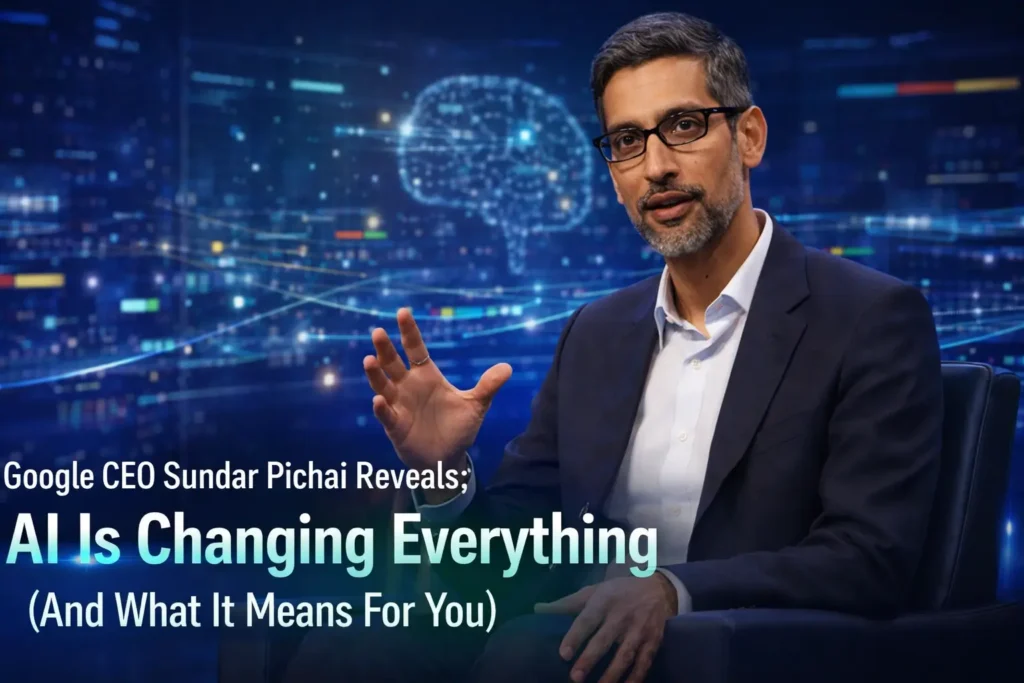
What happens when the man running one of the world’s most powerful tech companies sits down for an honest conversation about artificial intelligence? The answers might surprise you.
In a revealing BBC interview, Sundar Pichai, CEO of Google, pulled back the curtain on the AI revolution that’s reshaping our world right now. And trust me, what he shared is both exciting and a little unsettling.
The Biggest Tech Moment Since the Internet
Remember when the internet changed everything? Pichai says what’s happening with AI right now is even bigger.
“AI is the most profound technology humanity is ever working on,” he explained. Every decade brings something new—personal computers in the 80s, the internet in the 90s, smartphones in the 2000s. But AI? It’s on a completely different level.
Here’s what really caught my attention: Google is spending over $90 billion this year on AI infrastructure. Just four years ago, they were spending less than $30 billion. That’s not a typo—they’ve tripled their investment.
And it’s not just Google. When you add up what all the major tech companies are doing, we’re talking about over $1 trillion in AI investment happening right now.
Building the Future at Lightning Speed
Pichai dropped this bombshell: In the next couple of years, tech companies will build what normally would have taken 10 to 20 years to create.
Think about that for a second. Two decades of technological progress compressed into 24 months. That’s the pace we’re moving at.
Is It All Just Hype? The Billion-Dollar Question
Of course, everyone wants to know: Is this an AI bubble? Are we repeating the dot-com crash of the early 2000s?
Pichai’s answer was refreshingly honest. Yes, there’s rational excitement based on real progress. But yes, there’s also some irrational exuberance happening too.
He compared it to the internet boom: “There was clearly excess investment, but none of us would question whether the internet was profound.” The same thing will happen with AI, he believes.
Some companies will overinvest. Some will fail. But the technology itself? It’s here to stay.
What AI Can Actually Do For You (Right Now)
Let’s get practical. What does all this mean for regular people?
Right now, you can have intelligent conversations with AI about almost any topic. But Pichai says the real magic is coming in the next 12 months.
AI agents will be able to handle complex tasks for you:
- Shopping for birthday gifts
- Planning trips
- Researching treatment options your doctor recommends
- Helping you decide whether to invest in a particular stock
Imagine telling an AI, “I need to buy a birthday gift for my wife who loves gardening and mystery novels,” and it actually goes out and handles the entire shopping process. That’s what’s coming very soon.
The Job Question Everyone’s Asking
Here’s where things get real. Pichai acknowledges that AI will disrupt jobs. He has to—it’s already happening to lawyers, accountants, journalists, and creative professionals.
But he also points to history. When his mother got her first refrigerator, it “automated” some household tasks. Did that make life worse? No—it freed her up to do other things.
Still, let’s be honest: Not every AI story has a happy ending. Some jobs will change dramatically. Others might disappear entirely.
Pichai’s advice for parents and young people? Learn to use AI tools. The people who succeed in any profession—whether you’re a teacher, doctor, or engineer—will be those who know how to work with AI.
It’s not that AI will replace you. It’s that someone using AI will replace you if you don’t adapt.
The Truth Problem: AI Doesn’t Always Tell the Truth
Now here’s something Pichai wants you to understand: AI makes mistakes.
Google’s AI once suggested putting glue on pizza (yes, really). It wrongly accused someone of assault. These aren’t small errors.
Why does this happen? Because AI models work by predicting what comes next based on patterns. They’re not actually “thinking” or “understanding” like humans do.
Pichai’s warning is clear: “Don’t blindly trust everything AI says.”
This is crucial. As AI becomes more embedded in our daily lives—answering our questions, making recommendations, summarizing information—we need to remember it’s not infallible.
The Energy Crisis Nobody’s Talking About
Here’s a problem that keeps energy experts awake at night: AI uses massive amounts of electricity.
By the end of this decade, data centers will use more energy than the entire country of India. Let that sink in.
Google actually dropped its 2030 net-zero target timeline because AI growth is happening faster than they expected. They’re still committed to clean energy, but the math has changed.
The silver lining? All this energy demand is driving huge investments in nuclear fusion, small modular reactors, and renewable energy. Pichai believes this crisis will actually accelerate our move to cleaner energy sources.
Who Owns Creativity? The Copyright Debate
There’s a thorny question at the heart of AI: These systems were trained on books, articles, music, and art created by humans. Should those creators get paid when AI companies profit from their work?
Sir Elton John calls it “thievery on a grand scale.” He wants tech companies to ask permission and be transparent about how they use creative work.
Pichai says Google gives people the option to opt out of AI training and honors copyright in outputs. But the debate is far from settled, especially in Europe and the UK.
The Power Question: Should We Worry About Tech CEOs and Presidents?
Remember that photo from Trump’s inauguration? Tech CEOs sitting in the seats of honor, right next to the president?
It made a lot of people uncomfortable. These companies already have enormous power. Now they’re building the most powerful technology in history. And they’re getting cozy with political leaders.
Pichai’s response? This is an important moment for national security and economic prosperity. Tech leaders need to engage with governments to make sure AI delivers benefits and doesn’t cause harm.
Fair point. But it’s also fair to ask: Who’s watching the watchers?
What’s Next? A Peek Into the Future
Before we wrap up, Pichai revealed something fascinating: Quantum computing is where AI was five years ago.
In other words, there’s another revolutionary technology brewing in Google’s labs that most people haven’t heard about yet. In five years, we might be having the same conversation about quantum computers that we’re having about AI today.
Google’s already winning Nobel Prizes for their AI work (their AlphaFold system solved protein structures that would have taken hundreds of millions of years of PhD research).
The Bottom Line: Ready or Not, AI Is Here
After reading this interview, three things are crystal clear:
1. The AI revolution is real and moving incredibly fast. This isn’t hype—it’s happening.
2. Everyone needs to learn how to use these tools. Whether you’re 15 or 75, your ability to work with AI will determine your success.
3. We need to stay skeptical and engaged. AI isn’t magic, it makes mistakes, and it raises serious questions about jobs, energy, privacy, and power.
Sundar Pichai ended the interview by reminding us that we often take progress for granted. Five years ago, nobody believed we’d have driverless cars roaming San Francisco. Now it’s normal.
What seems impossible today might be boring and ordinary in just a few years.
The question isn’t whether AI will change your life. It already is. The question is: Are you ready to change with it?
What do you think about AI’s impact on your work and life? The conversation is just beginning, and everyone has a stake in how this technology develops.