Introduction
Artificial Intelligence (AI) has rapidly evolved from rule-based automation to systems capable of reasoning, planning, and autonomous action. Two terms—AI Agent and Agentic AI—have emerged at the forefront of this transformation, often used interchangeably but representing distinct paradigms in AI capability and application. Understanding the differences between AI Agents and Agentic AI is crucial for organizations, developers, and decision-makers seeking to harness the full potential of intelligent automation across industries.
This comprehensive article explores the definitions, historical evolution, technical architectures, key capabilities, direct comparisons, use cases across sectors, real-world examples, tools and platforms, evaluation metrics, safety and governance, and the challenges and future trends of AI Agents and Agentic AI. The goal is to provide a clear, SEO-optimized, and actionable guide for readers navigating the rapidly changing landscape of autonomous AI systems.
Definitions and Core Concepts
What Is an AI Agent?
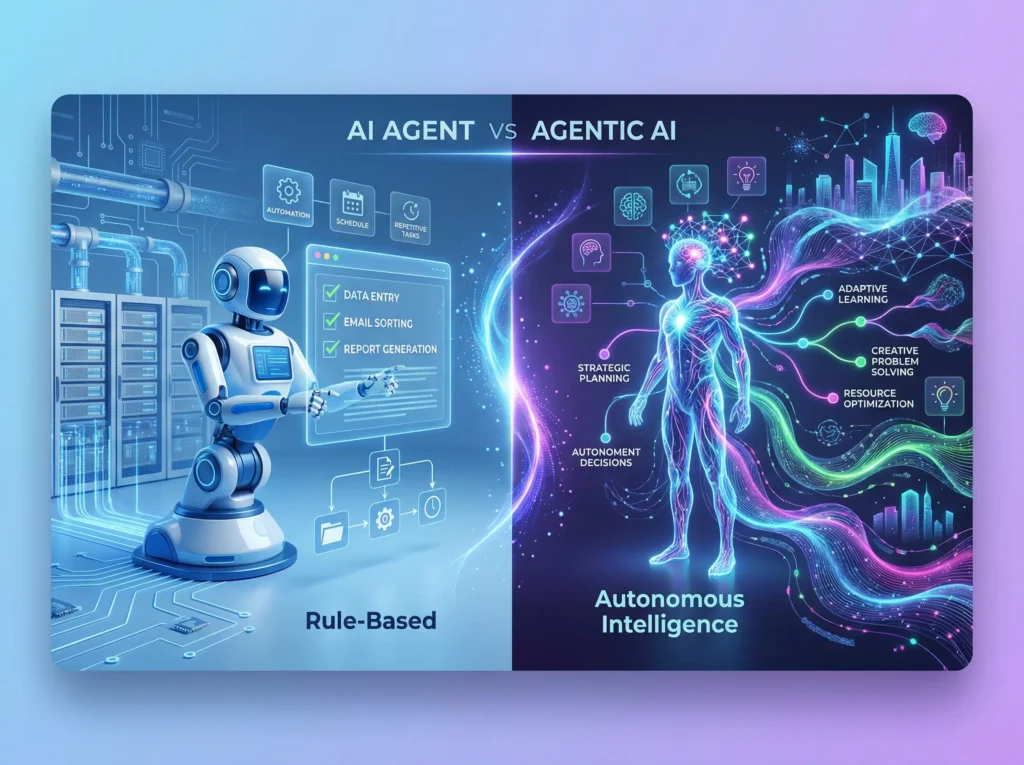
An AI Agent is a software system designed to perceive its environment, process data, and perform tasks automatically based on predefined rules or goals. AI Agents typically operate within a fixed scope, executing specific tasks when prompted or triggered, and often require human-defined objectives and boundaries.
Key characteristics of AI Agents:
- Task-specific autonomy: Operate independently within a defined domain (e.g., customer service, data entry, scheduling).
- Perception and action: Monitor inputs, process information, and execute responses.
- Goal-oriented behavior: Work toward specific, predefined objectives.
- Limited learning: May adapt within operational boundaries but generally do not plan or strategize beyond their scope.
- Tool integration: Can connect with APIs, databases, and external systems to complete tasks.
Examples: Chatbots, recommendation engines, virtual assistants (like Siri or Alexa), robotic process automation (RPA) bots, and fraud detection systems.
What Is Agentic AI?
Agentic AI refers to a more advanced AI architecture that enables autonomous planning, decision-making, and multi-step task execution with minimal human oversight. Agentic AI systems go beyond executing commands—they can determine objectives, break down goals into sub-tasks, adapt strategies in real time, and orchestrate workflows across multiple agents and tools.
Key characteristics of Agentic AI:
- Strategic autonomy: Makes high-level decisions about approach, resource allocation, and task prioritization.
- Multi-step reasoning: Breaks down complex goals into executable sub-tasks.
- Dynamic planning: Adjusts strategies based on outcomes and changing conditions.
- Cross-domain integration: Coordinates multiple specialized agents or tools.
- Adaptive learning: Refines strategies based on results and feedback.
- Orchestration: Manages the interaction and sequencing of multiple agents or components.
Examples: Autonomous research assistants, AI project managers, self-healing supply chains, agentic coding platforms, and multi-agent cybersecurity systems.
Historical Evolution and Taxonomy
Early Roots and Rule-Based Systems
The concept of agents in AI dates back to the mid-20th century, with early philosophical and computational models exploring the idea of autonomous entities capable of sensing and acting in their environment. Early AI agents were simple, rule-based systems—such as thermostats or expert systems like MYCIN—that could perform specific tasks but lacked adaptability and learning.
Emergence of Intelligent Agents
With advances in machine learning, neural networks, and reinforcement learning, AI agents became more sophisticated, capable of learning from data and adapting their behavior. The 1980s and 1990s saw the rise of multi-agent systems, distributed AI, and cognitive architectures that laid the groundwork for more complex agentic behaviors.
The Agentic Era
The advent of large language models (LLMs) and deep learning in the 2010s unlocked new possibilities for agentic behavior. LLMs provided general-purpose reasoning and communication capabilities, enabling agents to understand open-ended instructions and plan multi-step actions. The introduction of tool use, retrieval-augmented generation (RAG), and autonomous orchestration frameworks (e.g., AutoGPT, LangChain, CrewAI) marked the transition to Agentic AI—systems capable of independent goal-setting, planning, and execution across domains.
Taxonomy of Agentic Architectures
Agentic AI architectures can be classified as:
- Single-agent architecture: One agent operates independently, making decisions and taking actions without other agents.
- Multi-agent architecture: Multiple agents interact, collaborate, or compete to achieve individual or collective goals. This can be further divided into:
- Vertical (hierarchical): Higher-level agents oversee and guide lower-level agents.
- Horizontal (peer-based): Agents operate at the same level, collaborating as equals.
- Hybrid: Combines hierarchical and peer-based elements for flexibility and resilience.
Technical Architectures and Components
AI Agent Architecture
A typical AI Agent system includes:
- Perception layer: Collects data from the environment (text, images, voice, sensors).
- Decision engine: Uses rules, machine learning models, or prompts to decide what action to take.
- Action layer: Executes the task (replying, recommending, automating, notifying).
- Feedback loop: Learns from results and improves future performance (in more advanced agents).
Core components:
| Component | Description |
|---|---|
| Sensors | Gather information from the environment (e.g., cameras, APIs, logs) |
| Reasoning Engine | Processes data, applies logic or ML models, and makes decisions |
| Actuators | Perform actions in the environment (e.g., send messages, update records) |
| Memory | Stores context, past interactions, and learned patterns |
| Tool Integration | Connects to external APIs, databases, or software systems |
AI agents may be simple reflex agents (reactive), model-based agents (with internal state), goal-based agents (plan to achieve goals), or utility-based agents (optimize for utility).
Agentic AI Architecture
Agentic AI systems build on the agent model with additional layers for planning, orchestration, and adaptation:
- Goal Engine: Breaks down high-level goals into smaller tasks and creates execution plans.
- Reasoning and Planning Layer: Evaluates options and chooses the best path to reach the goal.
- Tool Integration Layer: Connects to external tools, APIs, databases, and applications.
- Memory System: Stores past interactions, context, and results to improve over time.
- Execution and Monitoring Loop: Performs tasks, tracks progress, and adjusts strategy until the goal is met.
- Orchestrator: Coordinates multiple agents, manages dependencies, and handles exceptions.
Agentic AI often employs:
- Retrieval-Augmented Generation (RAG): Combines search and generation for up-to-date, context-aware responses.
- Multi-agent orchestration: Specialized agents collaborate or compete, managed by an orchestrator or peer protocol.
- Persistent memory: Maintains context across sessions and tasks.
- Human-in-the-loop: Allows for oversight, escalation, and intervention at critical points.
Key Capabilities and Behaviors
AI Agent Capabilities
- Automation of repetitive tasks: Data entry, scheduling, basic customer queries.
- Rule-based decision-making: Follows predefined logic or workflows.
- Contextual response: Can use limited memory to personalize interactions.
- Tool access: Connects to APIs or databases for information retrieval or updates.
- Limited adaptation: May learn from feedback within a narrow scope.
Agentic AI Capabilities
- Autonomous goal pursuit: Interprets high-level objectives and plans multi-step strategies.
- Dynamic planning and reasoning: Adjusts approach based on real-time feedback and changing conditions.
- Multi-agent collaboration: Coordinates specialized agents for complex workflows.
- Cross-domain integration: Orchestrates actions across different systems, tools, and data sources.
- Continuous learning and adaptation: Refines strategies and improves performance over time.
- Proactive behavior: Initiates actions, anticipates needs, and handles exceptions without explicit prompts.
- Explainability and auditability: Maintains logs, provides rationales, and supports post-hoc analysis.
Direct Comparison and Key Differences
The following table summarizes the main differences between AI Agents and Agentic AI:
| Dimension | AI Agents | Agentic AI |
|---|---|---|
| Core function | Perform specific tasks | Orchestrate complex workflows |
| Scope | Narrow, domain-specific | Broad, cross-functional |
| Autonomy level | Task-specific decisions, human guidance | Strategic planning, minimal human intervention |
| Decision-making | Rule-based within boundaries | Goal-oriented with dynamic reasoning |
| Task complexity | Single-step or linear workflows | Multi-step, interdependent processes |
| Planning capability | Follows predefined plans | Creates and adapts plans |
| Learning focus | Optimize task execution | Improve strategic approaches |
| Proactiveness | Reactive (trigger-based) | Proactive (goal-driven) |
| Adaptation | Adjust within task parameters | Revise entire strategy as needed |
| Integration | Point-to-point connections | Network orchestration |
| Scale approach | Add more agents | Coordinate more components |
| Error handling | Retry or escalate | Develop alternative approaches |
| Time horizon | Immediate task completion | Long-term goal achievement |
| Resource management | Uses assigned resources | Allocates resources dynamically |
| Example outputs | Resolved ticket, updated record | Optimized process, strategic recommendation |
In essence:
- AI Agents optimize execution of defined tasks.
- Agentic AI optimizes outcomes by orchestrating strategy, planning, and adaptation across tasks and domains.
Use Cases Across Industries
Healthcare
AI Agents:
- Appointment scheduling bots.
- Automated patient reminders.
- Basic triage chatbots.
Agentic AI:
- Autonomous medical imaging analysis (e.g., PathAI, Zebra Medical Vision).
- Clinical decision support (e.g., IBM Watson for Oncology).
- Personalized patient care planning using genetic, lifestyle, and medical data.
- Hospital operations management (e.g., GE Healthcare’s AI operations agent).
- Predictive analytics for disease outbreaks (e.g., BlueDot, Google’s flu prediction AI).
Real-world example:
PathAI’s agentic system analyzes tissue samples for cancer detection, learning from thousands of biopsies to identify malignant cells with 99.5% accuracy, enabling earlier and more effective treatment.
Finance
AI Agents:
- Automated loan processing.
- KYC/AML compliance checks.
- Fraud detection bots.
Agentic AI:
- Autonomous algorithmic trading (e.g., agents achieving 200% annualized returns).
- End-to-end claims processing (multi-agent systems for insurance).
- Proactive risk management and portfolio optimization.
- Real-time financial reporting and regulatory filing.
- Personalized financial guidance and wealth management.
Real-world example:
A major U.S. regional bank deployed AI agents across voice and digital channels, supporting over 2.6 million customer sessions and handling more than 5 million minutes of automated voice interactions annually, with high containment and reduced pressure on live teams.
Supply Chain and Logistics
AI Agents:
- Inventory tracking bots.
- Automated order processing.
- Route optimization tools.
Agentic AI:
- Proactive orchestration agents for self-healing supply chains.
- Autonomous root cause analysis and scenario modeling.
- Dynamic resource allocation and demand forecasting.
- Multi-agent collaboration for end-to-end logistics optimization.
Real-world example:
Deloitte reports agentic supply chains enable manufacturers to manage risk, optimize inventory, and respond to disruptions in real time, resulting in millions in cost savings and improved resilience.
Cybersecurity and SecOps
AI Agents:
- Automated alert triage.
- Threat detection bots.
- Basic incident response scripts.
Agentic AI:
- Multi-agent SOC automation (e.g., Wiz’s Blue Agent for investigation, Red Agent for vulnerability validation).
- Autonomous threat hunting and response orchestration.
- Continuous risk and exposure management.
- Proactive containment and escalation with human-in-the-loop oversight.
Real-world example:
Grammarly cut tier-1 investigation times from 45 minutes to just four by integrating Wiz’s AI-enabled workflows, freeing engineers for strategic threat hunting and detection engineering.
Software Development and DevOps
AI Agents:
- Code completion assistants (e.g., GitHub Copilot).
- Automated test generation.
- Static code analysis bots.
Agentic AI:
- Agentic coding platforms (e.g., Gemini CLI, AutoGPT, BabyAGI) that plan, write, test, and modify code with minimal human intervention.
- End-to-end app development workflows (from requirements to deployment).
- Autonomous code refactoring and legacy modernization.
- Multi-agent orchestration for CI/CD pipeline optimization.
Real-world example:
A developer used OpenAI’s Operator and Replit’s AI Agent to build an entire app in 90 minutes, with agents autonomously exchanging credentials and running tests.
Customer Service and Support
AI Agents:
- Chatbots for FAQs and ticket triage.
- Automated email responders.
- Virtual assistants for routine queries.
Agentic AI:
- End-to-end workflow automation across channels (e.g., Fin by Intercom).
- Multi-step resolution of complex customer issues.
- Omnichannel support with memory and context retention.
- Escalation to human agents with full context and audit trails.
Real-world example:
Fin by Intercom automates customer conversations and executes support workflows across chat, email, voice, SMS, and social channels, integrating with external systems and supporting advanced multi-step tasks.
Real-World Examples and Case Studies
- Healthcare: Google’s AI agent detects diabetic retinopathy in eye scans with 97% accuracy, outperforming most human specialists and preventing blindness in underserved communities.
- Finance: AI trading agents process market data, predict trends, and execute trades with high precision, achieving significant returns and reducing operational risk.
- Supply Chain: Agentic AI systems enable self-healing supply chains, reducing bottlenecks and improving resilience during disruptions.
- Cybersecurity: Wiz’s Blue Agent automates investigation and containment, reducing analyst workload and improving response times.
- Software Development: Gemini CLI and AutoGPT enable agentic coding, where agents plan, write, test, and deploy code autonomously, accelerating development cycles.
- Customer Service: Fin by Intercom and Kore.ai provide agentic customer service platforms, automating multi-step workflows and improving resolution rates.
Tools, Platforms, and Vendors
Leading Platforms and Frameworks
- OpenAI Operator, AutoGPT, BabyAGI: Open-source frameworks for building agentic AI systems with autonomous planning and tool use.
- LangChain and LangGraph: Python frameworks for building deep agents, multi-agent workflows, and RAG-enabled applications.
- Microsoft Agent Framework: SDK for multi-agent orchestration, supporting sequential, concurrent, group chat, handoff, and magentic patterns.
- Google Gemini CLI and Antigravity: Agentic coding tools for autonomous software development and workflow automation.
- Kore.ai, Intercom Fin, Ada, Zendesk AI: Enterprise platforms for agentic customer service and support.
- Wiz, Microsoft Copilot Studio: Agentic cybersecurity and SOC automation platforms with governance and observability features.
Open-Source Projects
- AutoGPT: Automates multi-step tasks by chaining LLM calls and tool use.
- BabyAGI: Experimental framework for self-building autonomous agents.
- CrewAI, ReAct, LangChain: Enable multi-agent orchestration and advanced reasoning.
Market Leaders
- Microsoft, IBM, NVIDIA, Anthropic, OpenAI, Google, SAP, UiPath, Oracle: These companies lead the agentic AI market with robust cloud infrastructure, advanced AI research, and industry-specific solutions.
Multi-Agent Systems and Orchestration
Multi-Agent Systems (MAS) involve multiple agents interacting to achieve individual or collective goals. MAS architectures can be:
- Cooperative: Agents work together (e.g., drones in search-and-rescue).
- Competitive: Agents compete for resources (e.g., trading bots).
- Hierarchical: Structured with supervisors and subordinates.
- Heterogeneous: Agents with different skills or roles.
Orchestration patterns:
- Sequential: Linear pipeline, each agent processes the previous agent’s output.
- Concurrent: Agents work in parallel, providing independent analysis.
- Group chat: Agents contribute to a shared thread for consensus-building.
- Handoff: Dynamic delegation, agents transfer control as needed.
- Magentic: Manager agent builds and adapts a task ledger for open-ended problems.
Benefits:
- Specialization, scalability, maintainability, and optimization.
- Enables complex, cross-domain workflows that single agents cannot handle.
Memory, Context, and Retrieval (RAG)
Retrieval-Augmented Generation (RAG) enhances agentic AI by combining search and generation:
- External knowledge source: Stores domain-specific or general information.
- Retriever: Finds relevant data based on queries.
- Prompt augmentation: Combines retrieved data with user queries for context.
- LLM generator: Produces grounded, context-aware responses.
Benefits:
- Reduces hallucinations and outdated information.
- Supports domain-specific expertise and real-time data integration.
- Enables agents to maintain context across long-running tasks and multi-agent workflows.
Evaluation Metrics, Benchmarks, and ROI
Traditional metrics (accuracy, precision, recall) are insufficient for agentic systems. New metrics include:
- Task adherence: Does the agent’s response satisfy the original user request?
- Tool call accuracy: Did the agent use tools correctly and efficiently?
- Intent resolution: Did the agent understand and act on the user’s goal?
- Cost and efficiency: Token consumption, time complexity, and API costs.
- Explainability: Ability to provide rationales and audit trails for decisions.
- Reproducibility: Publishing prompts, configurations, and interaction logs for benchmarking.
Best practices:
- Use scoring rubrics or LLM-as-judge evaluations for open-ended outputs.
- Monitor token and resource usage per agent and orchestration run.
- Publish Thought-Action-Result (TAR) trajectories for explainable and reproducible evaluation.
Safety, Ethics, and Governance
Key considerations:
- Human-in-the-loop: Critical for oversight, especially in high-stakes or ambiguous scenarios.
- Auditability and transparency: Maintain logs, provide explanations, and support post-hoc analysis.
- Fairness and bias mitigation: Regular audits and bias detection mechanisms.
- Privacy and data security: Encryption, access controls, and compliance with regulations (e.g., HIPAA, GDPR).
- Accountability: Clear ownership models, escalation protocols, and liability frameworks.
- Regulatory compliance: Adherence to frameworks like NIST AI RMF, India AI Governance Guidelines, and sector-specific standards.
OWASP Top 10 for Agentic Applications (2026):
- Agent goal hijack, tool misuse, identity abuse, supply chain vulnerabilities, unexpected code execution, memory poisoning, insecure communication, cascading failures, trust exploitation, rogue agents.
Security Risks and Adversarial Threats
Risks:
- Prompt injection and goal hijacking: Malicious inputs redirect agent behavior.
- Tool misuse: Unsafe chaining or ambiguous instructions lead to exploitation.
- Identity and privilege abuse: Unauthorized access or actions via delegated trust.
- Memory/context poisoning: Corrupting stored context to bias future actions.
- Cascading failures: Single faults propagate across agents and workflows.
- Shadow agents: Unmonitored agents create security holes.
Mitigations:
- Authentication, secure networking, and principle of least privilege.
- Content safety guardrails at multiple points in the orchestration.
- Audit trails and real-time monitoring for anomaly detection.
- Human approval gates for high-risk actions and escalation protocols.
Explainability, Transparency, and Auditability
- Group chat orchestration: Provides transparency as all agents and humans emit output into a shared thread.
- Magentic orchestration: Maintains a complete audit trail of evolving plans and implementation steps.
- Explainable AI techniques: Provide rationales for decisions and support regulatory compliance.
Human-in-the-Loop, Oversight, and Control
- Critical for trust and accountability: Humans review, approve, and intervene at strategic points.
- Escalation protocols: Ensure that ambiguous or high-stakes decisions are handled by humans.
- Continuous monitoring: Dashboards, audits, and feedback loops to track agent performance and identify failure modes.
Implementation Patterns and Best Practices
- Start with the lowest complexity: Use single agents for simple tasks, multi-agent orchestration for complex workflows.
- Specialization: Assign clear responsibilities and interfaces to agents.
- Closed-loop evaluation: Embed metrics, feedback, and continuous improvement cycles.
- Test-driven development: Define expected behaviors and edge cases before deployment.
- Knowledge engineering: Persist decisions and context for institutional memory.
- Sandboxing and containment: Use isolated environments and kill switches to prevent drift and escalation.
- Clear accountability: Define ownership, monitoring, and intervention roles.
Limitations, Challenges, and Failure Modes
- Edge cases and ambiguity: Agentic AI struggles with messy, exception-heavy scenarios requiring human judgment.
- Language and domain gaps: Large models may miss industry-specific jargon or compliance requirements.
- Emotion and empathy limits: Bots can misread tone and escalate frustration.
- Transparency and explainability: Black-box decisions hinder regulatory compliance.
- Over-reliance on automation: Can lead to “false containment” and missed escalation opportunities.
- Coordination complexity: Multi-agent systems introduce overhead, latency, and new failure modes.
- Data quality and hallucinations: Poor or fragmented data leads to unreliable outputs.
- Regulatory uncertainty: Evolving legal frameworks create compliance challenges, especially in sensitive sectors.
Regulation and Legal Liability (Global and India)
- Global frameworks: NIST AI Risk Management Framework, EU AI Act, OWASP Top 10 for Agentic Applications.
- India: AI Governance Guidelines emphasize human-in-the-loop, auditability, explainability, fairness, and sectoral regulation. No separate AI law yet, but existing laws (IT, data protection, consumer protection) apply. Voluntary frameworks and techno-legal solutions are encouraged.
Market Trends, Vendors, and Adoption Forecasts
- Market size: The global agentic AI market was valued at USD 7.29 billion in 2025 and is projected to reach USD 139.19 billion by 2034, at a CAGR of 40.5%.
- Adoption: Enterprises lead adoption, driven by digital transformation, automation, and operational efficiency. Healthcare, finance, customer service, and supply chain are key sectors.
- Regional outlook: North America dominates, followed by Europe and Asia Pacific. India and China are rapidly growing markets.
- Key players: Microsoft, IBM, NVIDIA, Anthropic, OpenAI, Google, SAP, UiPath, Oracle, Zycus, Cognition AI, and others.
- Trends: Industry-specific solutions, low-code/no-code platforms, multi-agent orchestration, and integration with cloud and edge environments.
Skills, Teams, and Organizational Readiness
- Agentic engineers: New roles focused on designing, governing, and scaling intelligent workflows composed of multiple autonomous agents.
- Core skills: Process mastery, orchestration, evaluation, test-driven development, and knowledge engineering.
- Organizational readiness: Requires investment in training, governance, and cross-functional collaboration to safely scale agentic AI systems.
Practical Tutorials and Code Examples
- LangChain and LangGraph: Tutorials for building deep agents, multi-agent workflows, RAG agents, SQL agents, and customer support handoffs.
- Gemini CLI and Antigravity: Step-by-step guides for agentic coding, project scaffolding, and workflow automation.
- AutoGPT and BabyAGI: Open-source projects for experimenting with autonomous agent frameworks.
SEO, Article Structure, and On-Page Optimization
- Clear headings and subheadings: Facilitate scanning and comprehension.
- Strategic keyword placement: “AI Agent,” “Agentic AI,” “autonomous AI,” “multi-agent systems,” “agentic coding,” “agentic AI use cases.”
- Comparison tables and real-world examples: Enhance engagement and authority.
- Internal linking: Connects related topics (e.g., RAG, multi-agent orchestration, customer service automation).
- Actionable insights: Guides readers on selecting, implementing, and governing agentic AI systems.
Conclusion
The distinction between AI Agents and Agentic AI marks a pivotal shift in the evolution of artificial intelligence. While AI Agents remain indispensable for automating well-defined, repetitive tasks, Agentic AI represents the next frontier—enabling autonomous, goal-driven systems capable of orchestrating complex, multi-step workflows across domains. The adoption of agentic AI is accelerating across industries, driven by the need for intelligent automation, operational efficiency, and strategic decision-making.
However, with greater autonomy comes increased complexity, risk, and the need for robust governance. Organizations must invest in human-in-the-loop oversight, explainability, security, and continuous evaluation to harness the benefits of agentic AI while mitigating its challenges. As the market matures, the ability to design, orchestrate, and govern systems of intelligent agents will become a critical differentiator for enterprises seeking to lead in the era of autonomous AI.
Key Takeaway:
AI Agents optimize task execution; Agentic AI optimizes outcomes through strategy, planning, and adaptation. The future belongs to those who can engineer, govern, and scale intelligent systems that remember, improve, and collaborate—amplifying human potential in the process.